Short on garden space but longing for homegrown tomatoes? Growing tomatoes in containers works well on a patio or balcony: give each plant a roomy pot with drainage, full sun and steady watering.
This guide is part of a wider look at container vegetable gardening, and it covers pots, soil, support and routine care.
| Item | Value |
|---|---|
| Minimum pot per cherry tomato plant | 2-gallon pot (about 10-inch diameter) |
| Minimum pot per standard tomato plant | 4-gallon pot (about 12-14 inch diameter) |
| Direct sun needed | At least 6 hours per day |
| Minimum cage diameter | 24 inches |
| Temperature above which red pigments form poorly | 90°F |
These figures come from Iowa State University Extension. Guidance can change, so check the source before you rely on the numbers.
Choosing a pot size
Tomatoes need a lot of root room, so pot volume matters more than the look of the container. Iowa State University Extension advises at least a 2-gallon pot (about 10-inch diameter) for each cherry tomato plant. Standard tomatoes need at least a 4-gallon pot (about 12-14 inch diameter).
Bigger is usually better. Harvest to Table says a 5-gallon container can carry larger indeterminate or vining plants and hold enough moisture for three or more days in hot weather. Miniature varieties can manage in an 8-inch pot, roughly a one-gallon container.
The container material is less critical than the basics, which Iowa State University Extension sums up this way:
- Any container works if it has drainage holes in the bottom.
- Drill holes yourself in plastic or wooden containers that come without them.
- If you use wood, avoid treated lumber and choose red cedar or redwood.
- Lift the pot onto pot feet or wood strips so roots do not bake on a hot deck or patio, as Harvest to Table suggests.
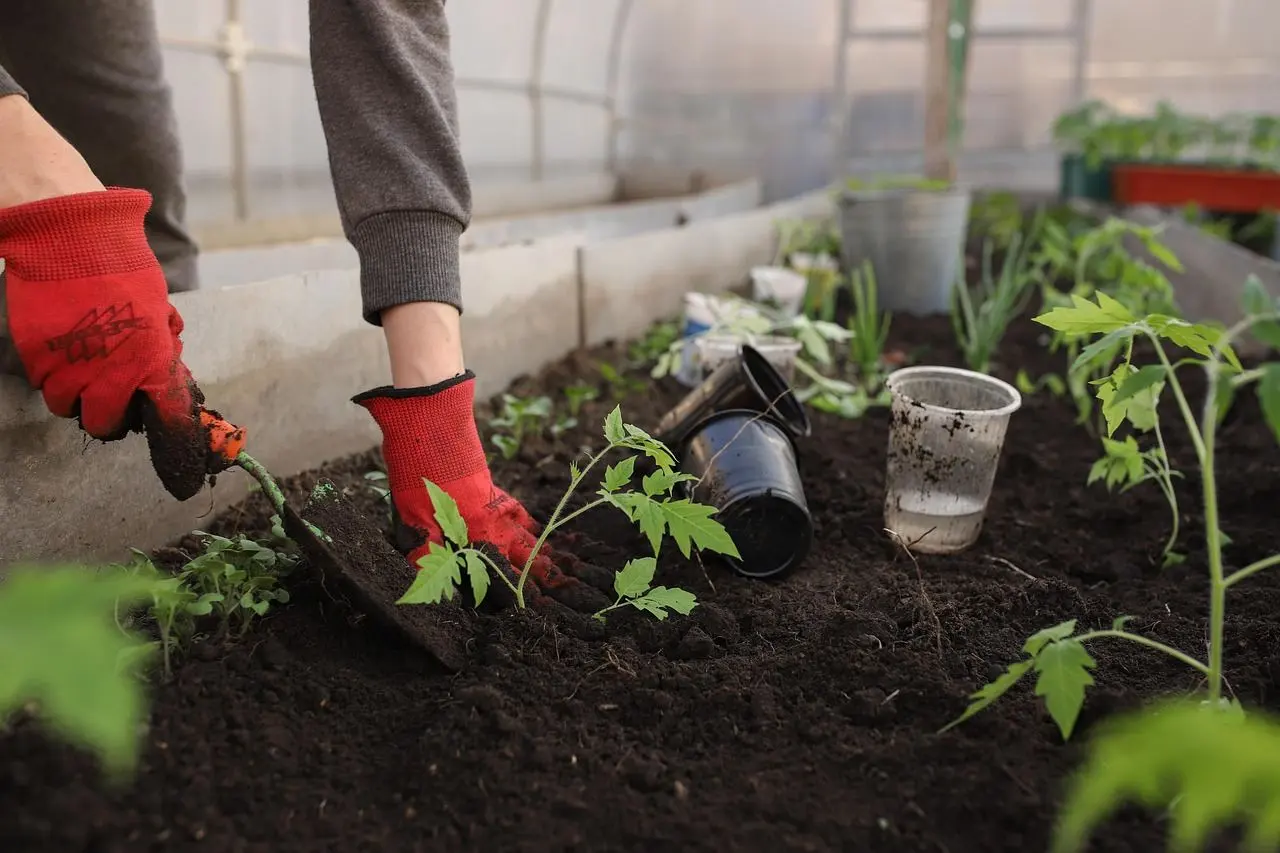
Potting mix and filling the pot
The mix has to drain well yet not dry out too fast. Iowa State University Extension favours a soilless potting mix over garden soil, and lists several advantages:
- It is free of plant disease organisms and weed seeds.
- It is less likely to compact.
- It holds moisture and plant nutrients well.
- It is lightweight, which makes the container easier to move.
Starting with a sterile mix also helps later on. The same source notes that leaf spot diseases and wilts are often less of a problem in container-grown plants for that reason (source).
When you fill the pot, leave a gap at the top. Harvest to Table suggests filling to about 2 inches below the rim so that watering has room to soak in instead of running over the edge.
Which tomato varieties suit pots?
Almost any tomato can grow in a pot, from tiny currant types to tall vining beefsteaks, provided the container holds enough soil to keep the plant upright and supply water and nutrients (Harvest to Table). Still, Iowa State University Extension says determinate and dwarf types tend to perform better because they are less likely to outgrow the container.
For very small spaces, Harvest to Table describes Tiny Tim as a small plant that grows to about 18 inches tall and can use a 6-inch pot. It also lists Bush Early Girl as a compact plant with very good flavor (source).
Early-maturing cultivars such as Early Girl, and many cherry and grape types, generally start producing earlier in summer than most others, according to Iowa State University Extension.
Sun, watering and feeding
Tomatoes crop best in full sun. Iowa State University Extension says plants need at least 6 hours of direct sunlight per day, so pick your sunniest spot.
Pots dry out fast under sun and wind, so frequent watering is part of the deal, and some plants may need it daily (source). The guide on how to water container plants covers routines in more detail. A few rules from the same source:
- Water until it drains from the bottom holes, then let the excess run out.
- Do not let the mix dry out completely between waterings, because plants may drop fruits and flowers.
- Avoid soggy conditions too, since over-watering starves roots of oxygen.
- Keep leaves dry where you can, especially late in the day, because wet leaves encourage disease.
Feeding matters more in pots than in the ground. A pot holds less soil, so fertilizer is needed more often, although many commercial mixes include a slow-release product that may delay the first feed until mid-summer (Iowa State University Extension). For the product type and amount, follow the label and your local extension guidance.
Staking, pruning and cages
Standard-sized varieties need a stake or cage to keep the vines upright (Iowa State University Extension). Cages should be at least 24 inches in diameter and made from mesh of at least 4-inch openings, so you can reach the fruit easily.
If you stake, train the plant to a manageable number of stems:
- Set the stake or cage firmly in the pot.
- Prune to one or two main stems by removing the small shoots in the leaf axils and along the stems.
- Pinch those shoots out early, since left alone they grow and make the plant hard to train.
- Tie the stems loosely to the stake.
Dwarf and small-plant types often need no support at all. Harvest to Table says small tomatoes require no staking or caging, though you can use it.
Harvest and common problems
Let fruit ripen fully on the plant, and pick it once the whole tomato is a uniform color. Ripe fruit feels slightly soft rather than hard like unripe green tomatoes, according to Iowa State University Extension.
Heat can change the color. The same source says red pigments do not form well above 90°F, so red varieties can look yellow-orange in a hot spell (source).
Most container problems trace back to water. Iowa State University Extension lists fruit cracking and blossom end rot as common when watering is inconsistent, so a steady routine is your best defence.
Gardeners planning more patio crops can also read about growing blueberries in pots.
Frequently asked questions
Do tomato containers need drainage holes?
Show answer
Yes. Nearly any vessel will do as long as water can leave through the base, and plastic or wooden pots without holes can be drilled. Treated lumber is best avoided for wooden boxes, per Iowa State University Extension.
Do tomatoes in pots need water every day?
Show answer
On hot, windy days many do, because small volumes of mix dry out quickly. Check the mix, water until liquid runs from the bottom, and avoid both bone-dry and waterlogged conditions (source).
What is the smallest pot I can use?
Show answer
For a cherry tomato, a 2-gallon pot is the floor that Iowa State University Extension gives. Compact miniature varieties are a different case, and Harvest to Table says some will grow in an 8-inch pot.
Why do my container tomatoes crack or get dark bottoms?
Show answer
Both cracking and blossom end rot are linked to uneven watering. Keeping the mix evenly moist, rather than swinging between dry and soaked, is the main fix (Iowa State University Extension).