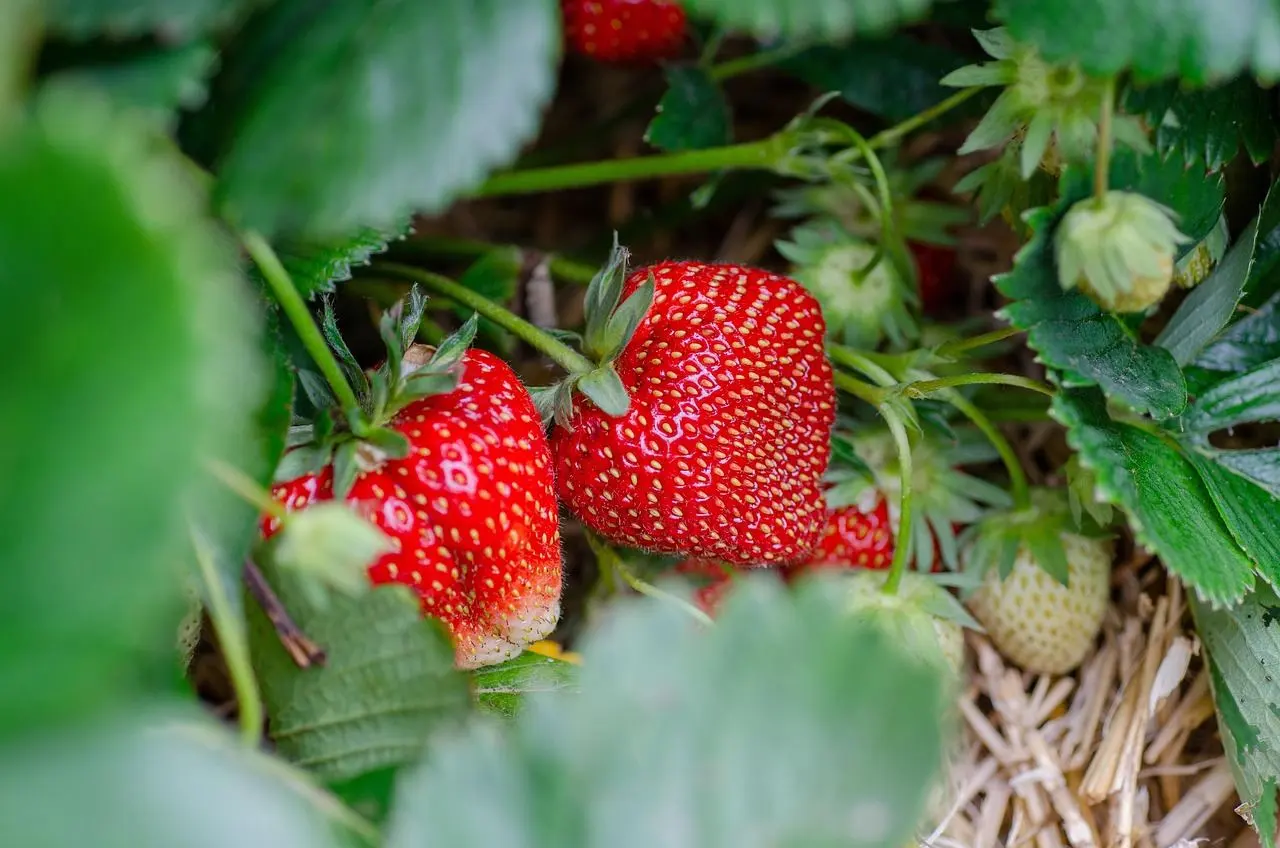
Worried you’ll plant strawberries and get no fruit? Here’s how to grow strawberries: pick a variety, give them sun and well-drained soil, and pinch off first-year flowers. Raised beds and containers work too.
This guide sits within a wider run of articles on vegetable gardening for beginners, so it assumes no earlier experience.
| Item | Value |
|---|---|
| Sun needed | At least 8 hours of full sun per day |
| Soil pH | 5.8 to 6.8 |
| Spacing in beds with plastic or mulch | 8 to 14 inches apart |
| Flowering to ripe berry | 28 to 30 days |
| Plant lifespan with proper care | Up to 3 years |
| Yield from a 4 feet by 8 feet bed | 10 to 15 pounds per year |
These figures come from West Virginia University Extension and Utah State University Extension. They can change and vary by region, so check the sources before you rely on them.
Which type of strawberry should you plant?
Growers sort strawberries into two classifications, as WVU Extension describes them: short-day or June-bearing, and day-neutral or ever-bearing. June-bearing varieties flower and fruit in May through June, while ever-bearing ones keep fruiting through the season with peaks in June and again in late summer to fall.
In most home gardens the labels blur. USU Extension notes that everbearers and day-neutrals behave similarly, and nurseries often use the two terms interchangeably.
WVU Extension advises keeping your growing conditions and your end goal in mind. A rough guide:
- June-bearing: a single heavy flush of fruit in late spring to early summer.
- Ever-bearing: berries spread across the season, with two peaks.
- Day-neutral: a steady, lighter picking. NDSU Extension says these are grown as annuals in North Dakota and suit containers or tunnels.
Strawberry varieties worth trying
No single variety suits every garden. USU Extension says a variety’s acceptability depends on soil type, local climate and personal taste, then lists several that have done well across a wide range of conditions:
- Earliglow (June-bearing): among the earliest to fruit and considered by many the gold standard for flavor.
- Allstar (June-bearing): a midseason choice that tolerates hot weather and resists root rot, powdery mildew and Verticillium wilt.
- Jewel (June-bearing): cold hardy, with late-season large fruit and a consistent habit.
- Seascape (day-neutral): productive in a wide range of climates.
Whatever you choose, USU Extension says to start with clean, disease- and virus-free plants from a reputable nursery. It also warns against moving plants from an existing bed, since they may carry viruses or root rot.
Where and how to plant strawberries
Start with a sunny, well-drained spot. USU Extension says strawberries need at least 8 hours of full sun each day to crop at their maximum, and WVU Extension gives a soil pH of 5.8 to 6.8.
Raised beds are ideal, according to WVU Extension, because they help with drainage, soil warming, weed control and picking. USU Extension adds that they improve drainage and aeration in heavy soils. If you are still deciding where beds will go, the guide on how to plan a vegetable garden can help you find a sunny corner.
Late frost is the other site risk. Rutgers Cooperative Extension says strawberries flower while frost can still kill the blossoms, so it advises avoiding low-lying frost pockets. USU Extension suggests covering blooming plants with tarps or blankets on cold nights.
Test the soil before you add anything. WVU Extension highly recommends a soil test to guide fertilizer choices, and you should follow the product label and local extension guidance for anything you apply.
Buying and planting steps
Per WVU Extension, bare-root plants are typically planted in early spring and plugs in the fall. Bare-root plants are dormant and should go in shortly after they arrive.
- Soak bare-root roots before planting. WVU Extension says about a half-hour, while UVM Extension says about an hour.
- Space the plants. WVU Extension gives 8 to 14 inches apart in beds with plastic or mulch, or 12 to 24 inches apart with 36 to 48 inches between rows if beds are not used.
- Set each crown at the soil line, as CSU Extension advises.
- Water in well, per UVM Extension.
- Remove the first set of flower buds and runners to build strong roots, as WVU Extension recommends.
Caring for strawberries through the season
Illinois Extension says strawberries need about 1 inch of water per week during the growing season. WVU Extension cautions that overwatering dilutes berry flavor, and suggests watering by hand only in the early morning or late evening.
Weeding matters because plants compete poorly. WVU Extension recommends removing weeds weekly and using straw if you mulch, and it warns that grass clippings or leaves can cause pest problems, smother plants or block water.
Runners are the other regular job. WVU Extension says removing runners gives a larger harvest and bigger berries.
Winter protection depends on your climate. WVU Extension says plants need mulch or row covers to guard against freezing temperatures, and NDSU Extension suggests a 4-inch layer of clean straw once the ground is frozen. CSU Extension recommends two inches and warns that more could smother the plants.
Plan ahead for disease and pests:
- Avoid beds where tomatoes, eggplants, potatoes or peppers grew within the past three years, because they can share diseases, per WVU Extension.
- Pick ripe fruit promptly, since sap beetles bore into overripe berries.
- If you also grow potted herbs nearby, how to grow herbs at home covers the basics of keeping them thriving.
Harvesting and renewing your bed
Timing depends on the type. WVU Extension says day-neutral varieties can bear fruit three months after planting in optimal conditions, while June-bearing plants fruit the following spring. Berries typically ripen 28 to 30 days after flowering.
WVU Extension gives three picking habits:
- Harvest red, fully ripe berries after the plants have dried in the morning.
- Pick about every three days.
- Refrigerate after picking and wash only when you are ready to eat.
A well-kept bed can pay off for several seasons. USU Extension says a properly maintained 4 feet by 8 feet bed will produce 10 to 15 pounds of berries per year, while WVU Extension says plants can last up to 3 years with proper care and pest control.
Once plants decline, renew the bed. Illinois Extension advises renovating matted-row plantings right after harvest, and says weedy or diseased plantings are best destroyed and replaced.
Frequently asked questions
Can strawberries grow in pots?
Show answer
Yes. WVU Extension lists containers and hanging baskets among the places perennial strawberries can grow. UVM Extension suggests a pot if your garden has no full-sun spot, because you can move it to a suitable place.
Should I let new plants fruit in their first year?
Show answer
Generally not. Illinois Extension says letting fruit develop in the first season delays root and runner development and cuts the following year’s crop. Everbearing and day-neutral plants are different: flowers that open after July can be left to give a fall crop.
Do strawberries need bees?
Show answer
Not entirely. WVU Extension says strawberry flowers can self-pollinate and wind moves some pollen, but bees and other pollinator insects are needed for complete pollination. That fuller pollination produces a larger berry and a longer harvest.
When is the best time to plant?
Show answer
Spring suits most gardens. Illinois Extension says to plant as soon as the ground can be prepared, and UVM Extension names spring or early summer and fall as the best windows while advising against planting in excessive heat.